2027: Where the Tech Bros and the Astrology Girls Agree
On Human Design, artificial intelligence, individual sovereignty, and the strange convergence of two seemingly opposing worldviews.

Something I’ve been finding particularly interesting lately is the overlap between two communities on X that, at first glance, seem to have very little in common: the tech bros and the astrology girls.
One group spends its time discussing artificial intelligence, automation, economics, and the future of technology. The other is studying planetary transits, Human Design, historical cycles, and esoteric literature. You would think these two groups would have almost nothing to agree on.
And yet, when it comes to their predictions about the next few years, they’re saying some remarkably similar things.
Both communities anticipate a major restructuring of society, particularly concerning how we work, make money, interact with institutions, and ultimately sustain ourselves. Both emphasize the importance of individual autonomy, adaptability, and developing skills that allow people to function independently of traditional systems.
And perhaps most interestingly, both keep coming back to the same year: 2027.
Of course, the methods by which they’re arriving at these conclusions are completely different. One is extrapolating from technological developments and economic trends, while the other is interpreting astrological patterns and esoteric frameworks.
But does the difference in methodology necessarily make the similarities in their conclusions any less interesting?
I don’t think so.
I’ve been collecting posts about this for a while now, particularly from @iJaadee, whose work on Human Design and the 2027 global cycle heavily inspired this piece. I wanted to try to make sense of these recurring predictions and examine where they intersect.
I’m not necessarily suggesting that the stars are predicting the development of AGI, or that Silicon Valley engineers have unknowingly become astrologers. Although that would be pretty funny.
Rather, I’m interested in what happens when two seemingly incompatible ways of understanding the world begin describing a similar future.
So, what’s the significance of 2027?
To understand the esoteric side of this conversation, we first have to look at Human Design.
Human Design is a system developed by Ra Uru Hu in the late 1980s that combines elements of astrology, the I Ching, the Kabbalah, the chakra system, and other spiritual traditions. The system describes individuals according to their unique energetic configurations, but it also contains a broader theory about the evolution of humanity.
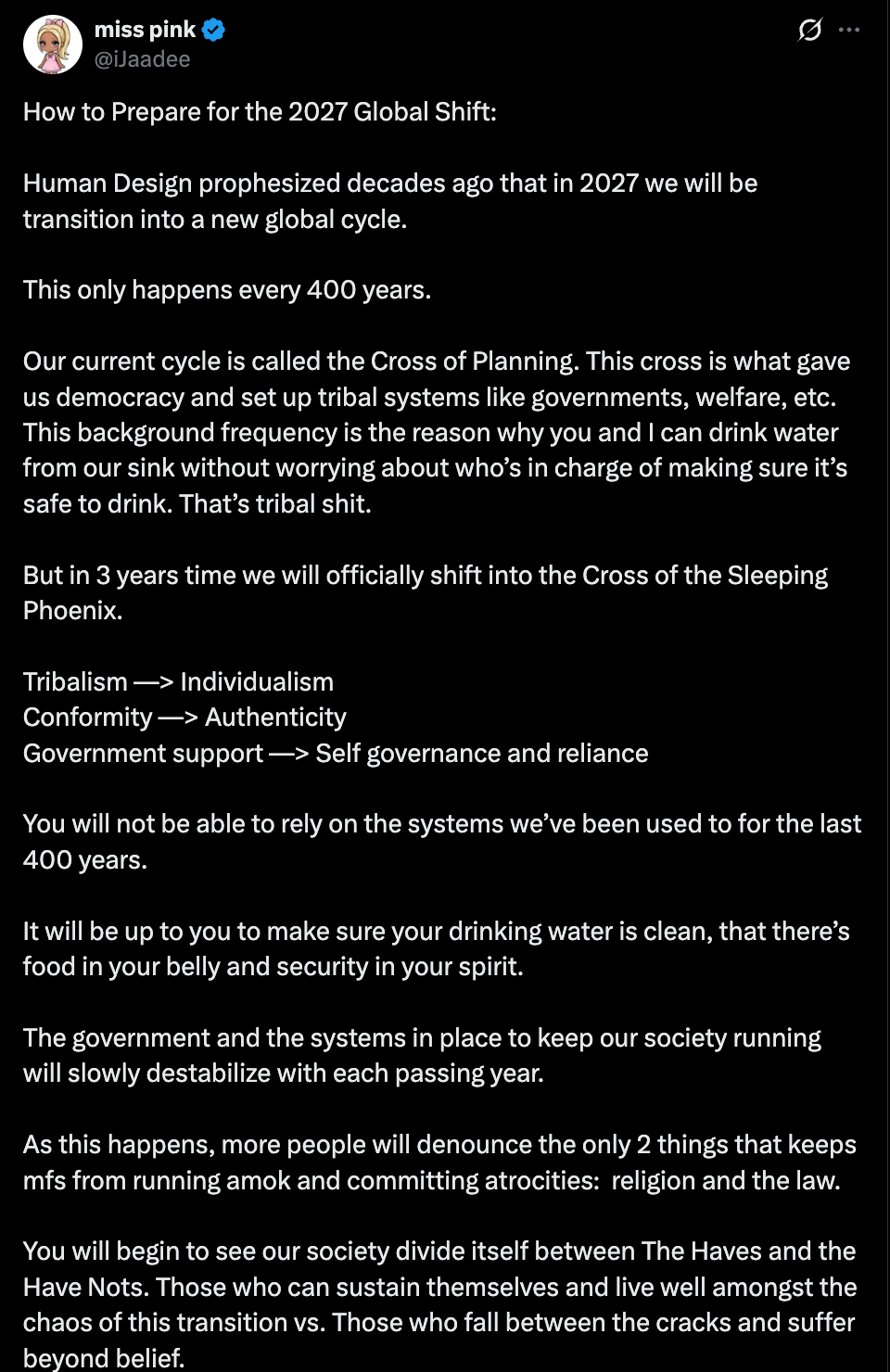
According to Human Design teachings, humanity has been living under a global cycle known as the Cross of Planning since approximately 1615.
This cycle is associated with collective survival, cooperation, social contracts, and the development of institutions. Think governments, schools, hospitals, public infrastructure, welfare systems, and the various agreements that allow millions of people to live together without having to personally manage every aspect of their survival.
You don’t necessarily think about who’s maintaining the electrical grid when you turn on your lights. You don’t have to personally test the water every time you turn on your faucet. These are responsibilities that we’ve collectively delegated to institutions.
In Human Design, this orientation toward collective support is a defining characteristic of the Cross of Planning.
However, in 2027, this approximately 400-year cycle is said to give way to a new one known as the Cross of the Sleeping Phoenix.
And its underlying theme is quite different.
Rather than collective security, this new cycle emphasizes individual sovereignty, authenticity, self-reliance, and personal survival. The idea is that the institutions we’ve become accustomed to relying upon will gradually lose some of their ability to organize and support society, leaving individuals with considerably more responsibility for their own lives.
The transition is not supposed to happen overnight. Nobody is suggesting that the calendar will turn to 2027 and suddenly every government, hospital, and financial institution will spontaneously combust.
At least, I hope not.
Instead, 2027 is understood as the beginning of a much longer transition whose consequences could unfold over decades.
Now, I think it’s important to distinguish the internal logic of Human Design from an empirically established theory of history. There’s no scientific basis for concluding that an energetic cycle will cause governments to weaken in 2027.
But the sociological implications of the prediction are interesting regardless of whether you believe in the system itself.
Because when I look at what people in the technology industry are discussing, I see a similar argument emerging from an entirely different direction.
The technological case for 2027
In June 2024, former OpenAI researcher Leopold Aschenbrenner published Situational Awareness: The Decade Ahead, in which he argued that artificial general intelligence (AGI) could plausibly arrive by 2027, followed by increasingly powerful forms of artificial intelligence.
His argument was based on trends in computing power, algorithmic efficiency, and improvements in AI capabilities as opposed to astrology and Human Design.
The general idea is that, if these trends continue, AI systems could soon perform increasingly complex cognitive tasks, including some of the research and engineering work required to develop future AI systems.
The implications extend well beyond chatbots generating text and images. We’re talking about the possibility of software agents conducting research, writing code, managing workflows, and coordinating with other artificial intelligence systems to accomplish tasks that previously required entire teams of human beings.
Aschenbrenner is clear that these projections carry substantial uncertainty. Nevertheless, the possibility of such developments within the next few years has generated an enormous amount of discussion within the technology community.
And here’s where things become interesting.
As AI becomes more capable, the relationship between individuals, employers, and institutions could begin changing quite dramatically.
Historically, accomplishing anything at scale required considerable resources. If you wanted to build a company, you generally needed employees, infrastructure, specialized expertise, and substantial capital.
But what happens when a single person can coordinate the output of what previously would have required an entire company?
Tech entrepreneur Greg Isenberg has discussed this trajectory in terms of increasing individual leverage, tracing the progression from the internet and social media to automation, AI agents, and eventually more autonomous businesses.
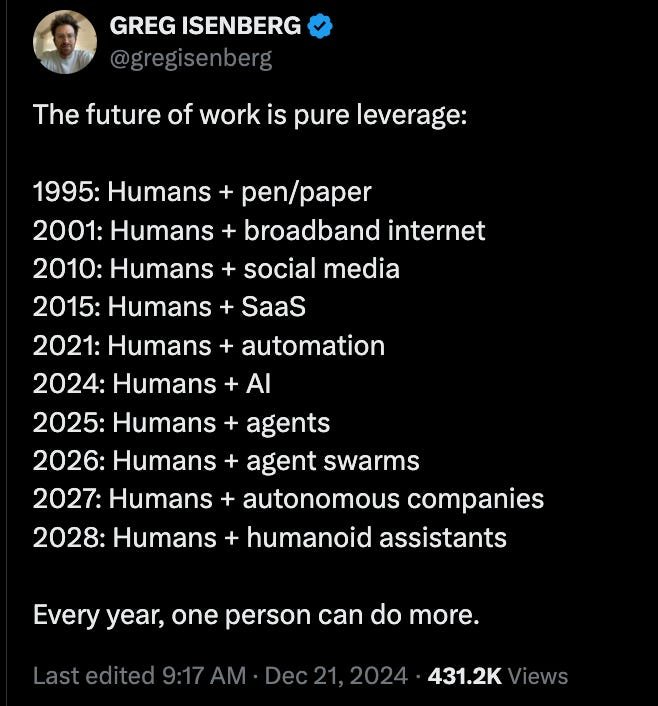
Of course, the precise timelines for autonomous companies and humanoid assistants remain speculative.
But the broader direction is worth considering. Technology has already made it substantially easier for individuals to access information, distribute their work, create products, and reach audiences without the same institutional resources that were once necessary.
And AI could accelerate this process even further.
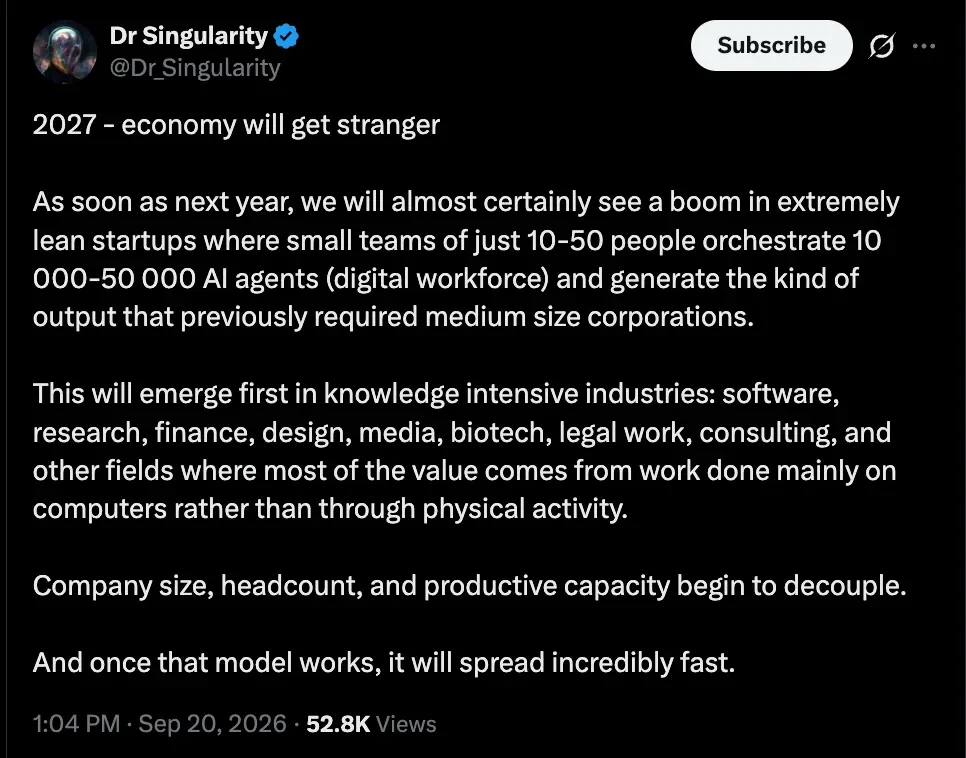
What I find fascinating is how closely this resembles the individual-centered future described in Human Design.
The astrology girls are describing a world in which individuals must increasingly depend on themselves because collective structures may become less reliable.
The tech bros are describing a world in which individuals can increasingly depend on themselves because technology makes them less reliant on those structures.
Potayto Potahto… Perhaps both are identifying different aspects of the same broader social transformation.
From institutional dependence to individual sovereignty
For most of modern history, we’ve been encouraged to follow a fairly recognizable path.
Go to school. Get a degree. Find employment. Earn a salary. Build savings. Eventually retire.
The stability of this arrangement depends on a certain level of confidence in the institutions supporting it.
You trust that your education will improve your employment prospects, that your employer will provide a reliable income, that your savings will retain value, and that the broader political and economic systems will remain sufficiently functional for you to plan your future.
But what happens when that confidence starts to erode?
From a technological perspective, automation raises legitimate questions about the long-term organization of employment. If increasingly sophisticated AI systems can perform certain tasks faster and more cheaply than human workers, the economic value of those tasks could change.
From the esoteric perspective, the Cross of the Sleeping Phoenix is associated with a gradual dissolution of collective arrangements and a greater emphasis on personal responsibility.
Both narratives suggest that the relationship between individuals and institutions could become less predictable.
But there’s an important distinction here: Institutions becoming less necessary for certain kinds of work is not the same thing as institutions becoming unnecessary for society.
A person might be able to start a software company without hiring employees, but that same person still relies on electricity, internet infrastructure, legal systems, transportation networks, and countless other collectively maintained resources.
In other words, technological independence does not necessarily mean social independence.
And the ability to function autonomously is not evenly distributed.
This brings me to another prediction I’ve repeatedly encountered: the possibility of an increasingly K-shaped economy.
A K-shaped economy describes a situation in which different groups experience sharply divergent economic outcomes. Some become wealthier and more prosperous while others stagnate or fall further behind. Aka “the permanent underclass” vs the “technocratic bourgeoisie.”
Now imagine what happens if access to capital, advanced technology, digital skills, and professional networks becomes an increasingly important determinant of economic opportunity.
Individuals who can effectively use these resources might find themselves with extraordinary new opportunities.
Meanwhile, those without access to the same resources could encounter greater economic insecurity, particularly if traditional employment and public support systems are simultaneously under pressure.
This is one of the darker implications of the individual-sovereignty narrative.
Because while increased autonomy sounds liberating, there’s a difference between choosing independence and having independence forced upon you.
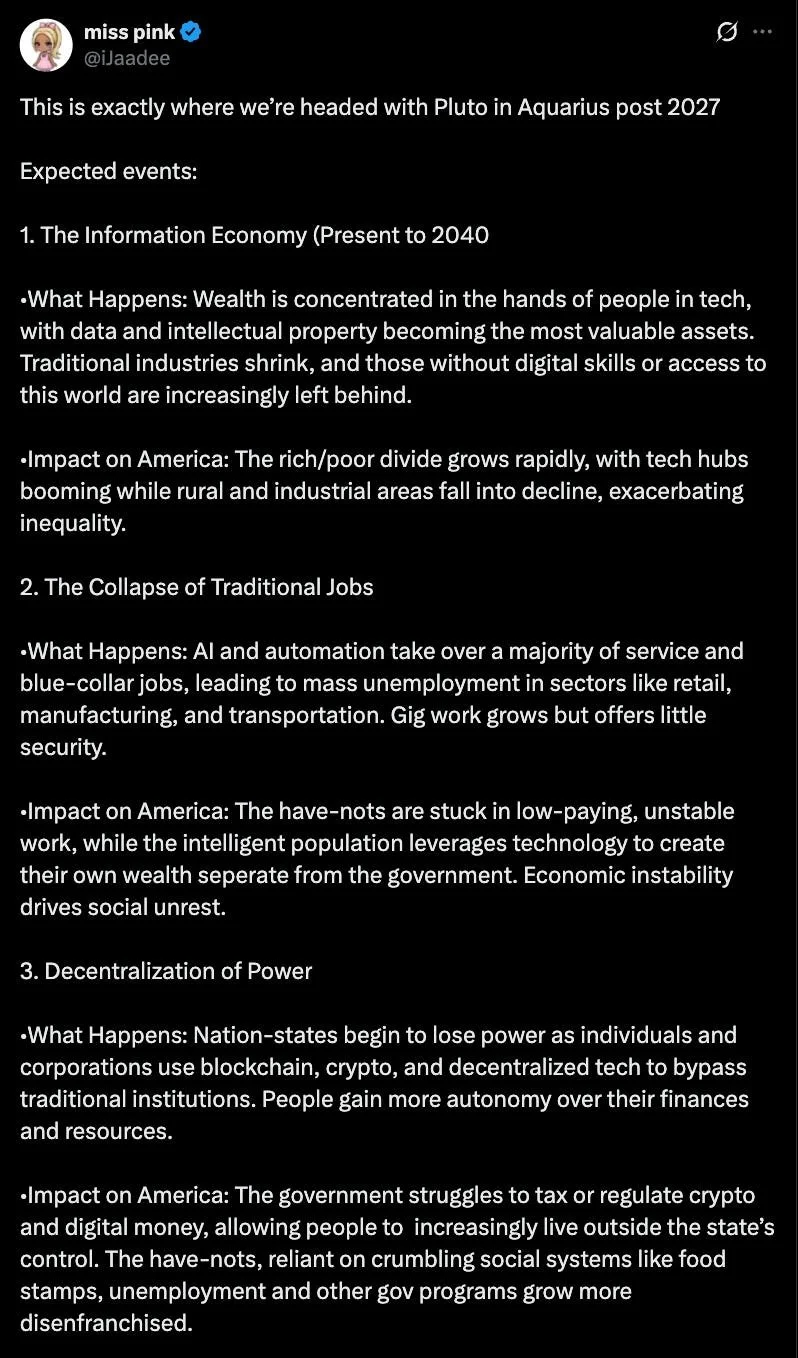
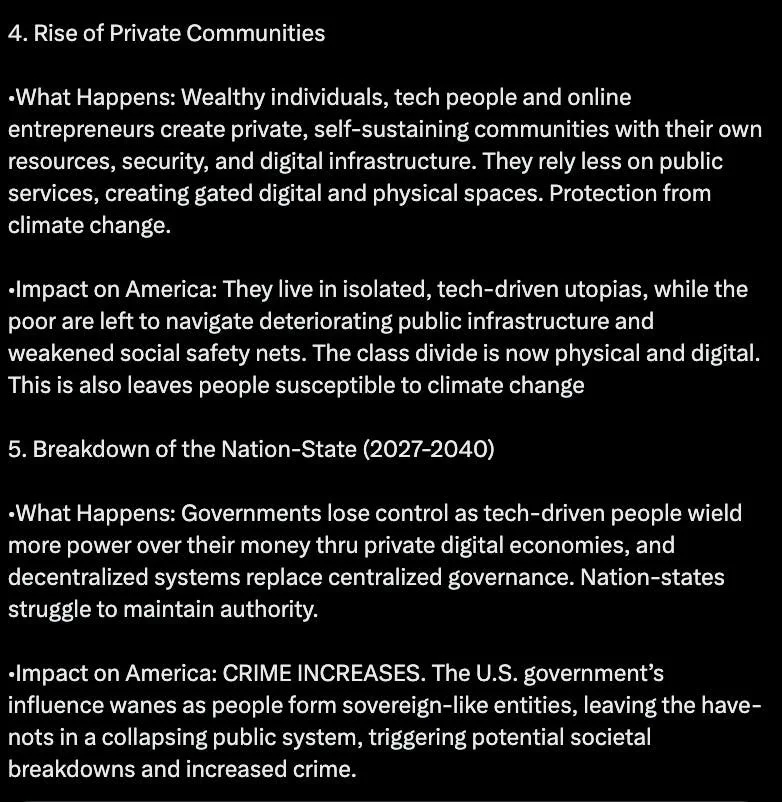
An increasingly individualized society could produce an unprecedented expansion of personal freedom. But it could also deepen existing inequalities if the resources necessary to exercise that freedom remain concentrated among a relatively small portion of the population.
And I don’t think we should confuse the ability to survive independently with the moral obligation to survive without help.
Creativity, AI, and the individual economy
One of the more optimistic predictions that appears throughout both communities concerns the growing economic importance of creativity.
In the Human Design discourse, particularly in Jade’s posts, there’s a recurring emphasis on identifying your natural interests, developing your talents, and finding ways to sustain yourself through work that feels personally meaningful.
The underlying argument is that individuals will increasingly benefit from pursuing their own distinctive abilities rather than conforming to conventional expectations about what work should look like.
In the technology community, a similar argument is emerging around AI and the declining costs of entrepreneurship.
Software development, graphic design, research, marketing, and other tasks that previously required specialized labor or significant financial investment can now be accelerated through AI tools.
A person with an idea might be able to build a prototype, launch a website, create promotional material, and reach potential customers with far fewer resources than would have been necessary a decade ago.
This doesn’t guarantee that the resulting business will succeed, of course.
But it does change who has the opportunity to try.
For a long time, the ability to transform creativity into economic value was constrained by access to capital, technical knowledge, distribution, and institutional gatekeepers.
Technology has been weakening some of those barriers for years, and AI could potentially weaken them further.
Something else worth considering is what happens to the value of human creativity when artificial creativity becomes abundant.
There are already people who view generative AI as a threat to artists, writers, musicians, and other creative professionals.
And I think some of those concerns are legitimate, particularly when discussing intellectual property, compensation, and the displacement of creative labor.
But there’s also a more optimistic possibility.
If AI-generated content becomes increasingly abundant, perhaps work that is recognizably human-made becomes more meaningful to certain audiences.
Or perhaps the most interesting creative work comes from people who learn to combine their own ideas and sensibilities with these new technological tools.
I’m not convinced that creativity automatically becomes more profitable simply because we’re entering an age of AI. Increased production also means increased competition and an almost unimaginable amount of content.
But I do think there’s something compelling about the possibility that technology could allow more individuals to experiment with creative entrepreneurship without needing permission from an employer, publisher, investor, or institution.
And maybe that’s another expression of the individual sovereignty both communities are describing.
Independence doesn’t have to mean isolation
There’s something else about the individualist narrative that I think is worth examining.
When we talk about self-reliance, we often imagine independence from other people. The ability to make our own money, make our own decisions, and organize our lives according to our personal interests.
But I don’t think genuine autonomy necessarily requires isolation.
In fact, a world with fewer rigid institutional structures might make interpersonal relationships and voluntary communities even more important.
Jade has written about the possibility of professional and social opportunities becoming increasingly dependent on referrals, relationships, and access to specific networks.
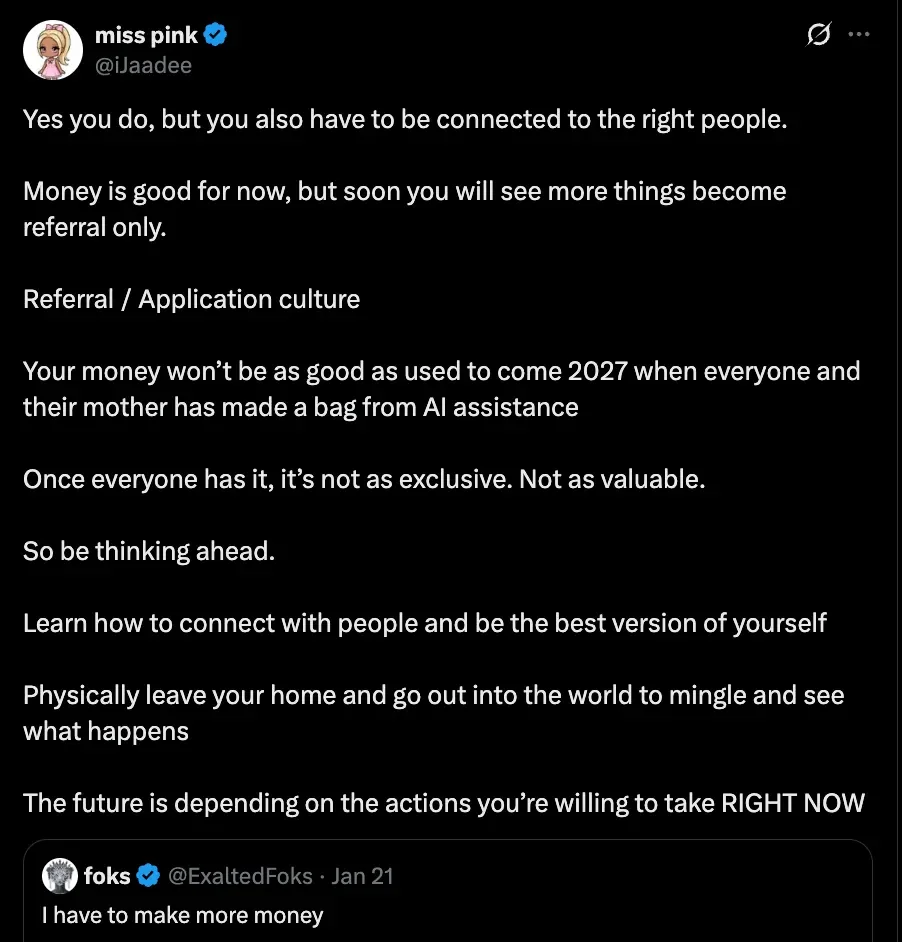
There’s an interesting distinction between depending on an institution and participating in a network of individuals who voluntarily support one another.
Both involve relationships of dependence, but those relationships are organized differently.
And perhaps the same idea extends beyond our professional lives.
Within Human Design, the anticipated 2027 transition also includes predictions about changing emotional dynamics, relationships, and family structures. Certain interpretations suggest that future relationships will place greater emphasis on emotional independence, mutual empowerment, and personal authenticity rather than obligation or codependence.
The less glamorous side of independence
Of course, there’s a considerably less romantic dimension to all of this.
If we entertain the possibility that society is moving toward greater individual responsibility, then the question of preparedness becomes relevant.
And I’m not talking exclusively about starting an online business or learning how to use ChatGPT.
The more extreme 2027 predictions include institutional instability, cybersecurity threats, financial restructuring, disruptions to infrastructure, climate migration, and increasingly unpredictable geopolitical conditions.
Some of these predictions are undoubtedly speculative, and I don’t think there’s sufficient evidence to confidently forecast the collapse of banking systems, widespread blackouts, or the dissolution of governments on a particular timeline.
But we don’t necessarily have to believe in an impending civilizational collapse to recognize the value of becoming more resilient.
This might mean developing a better understanding of cybersecurity, protecting personal accounts and digital assets, maintaining copies of important documents, and becoming more familiar with emerging financial technologies.
One point from Jade’s writing that I found particularly interesting concerns the preservation of personal data.
We tend to treat our digital histories as though they’re permanent. Our photographs, videos, writing, social media archives, and other records are stored across platforms that we implicitly trust to preserve them.
But what happens if a platform shuts down, changes its policies, or simply loses access to the information we’ve accumulated over the years?
There’s also an entirely different consideration involving the possibility of using personal archives to develop more individualized AI systems in the future.
Imagine an artificial intelligence system that could draw upon years of your writing, photographs, recordings, and personal records to better understand your preferences, creative history, and ways of thinking.
Your digital history could become more than a collection of memories. It could become a resource for building tools that are meaningfully personalized to you.
Whether or not that becomes economically valuable, preserving access to your own information seems like a reasonable precaution.
The same general principle applies to understanding digital ownership, financial security, and the basic technologies upon which our lives increasingly depend.
And perhaps even to maintaining enough financial flexibility to relocate or respond to unexpected circumstances.
There’s value in asking how much control we actually have over the systems we depend upon and how much control we’d like to have.
So, is something actually happening in 2027?
I think this is where the philosophical questions become particularly interesting.
When two different communities arrive at similar conclusions about the future, how should we interpret that convergence?
One possibility is that they’re identifying the same underlying patterns through different conceptual frameworks.
Another is that both communities are responding to the same widespread uncertainty about technological progress, economic instability, and institutional change.
And another, of course, is coincidence.
There’s also a question of confirmation bias. If we’re already convinced that 2027 is going to be a transformative year, we’ll naturally become more attentive to predictions and developments that reinforce that belief. Hyperstition?
A Human Design practitioner might interpret growing institutional distrust as evidence of the Cross of Planning coming to an end.
A technology investor might interpret the same uncertainty as evidence of an impending economic transformation driven by AI.
As someone interested in both philosophy and emerging technology, I don’t see why I should have to dismiss an entire interpretive framework simply because its underlying assumptions aren’t scientifically established.
But I also don’t think being open-minded means treating every prediction as equally credible.
There’s a difference between finding a theory intellectually stimulating and believing that it provides a reliable account of reality.
We seem to be living through a period in which many of the arrangements that previously structured our lives are being questioned. The relationship between education and employment, the role of governments and corporations, the value of creative labor, and even the distinction between human and machine intelligence are all becoming increasingly complicated.
Whether we explain these developments through technological progress, economics, astrology, or some combination of the three, there’s a recurring sense that the world is entering unfamiliar territory…..
Maybe there will be a part two. For now, I mostly wanted to put some initial feelers out there and see what other people think.
This piece was heavily inspired by @iJaadee and the broader conversations surrounding Human Design, artificial intelligence, and the future of individual sovereignty. The predictions discussed are speculative and should not be interpreted as established facts or guarantees of future events.
